


Genomebeans bulk transcriptomics pipeline is a sequencing data analysis tool that supports an extensive workflow for the analysis and visualization of RNA-Seq data. It identifies gene expression pattern enhancing our understanding of transcriptional activity. It also enables analysis of coding and noncoding RNA with the high-confidence, discovery of features such as alternative transcripts, gene fusions, allele-specific expression, and the detection of novel transcripts in both coding and non-coding RNA species.
It uses functionalities of high thoughtput next generation sequencing to get insight about cells transcriptome. It is most valuable and extensively used tool for diagnostics of any pathogenesis.
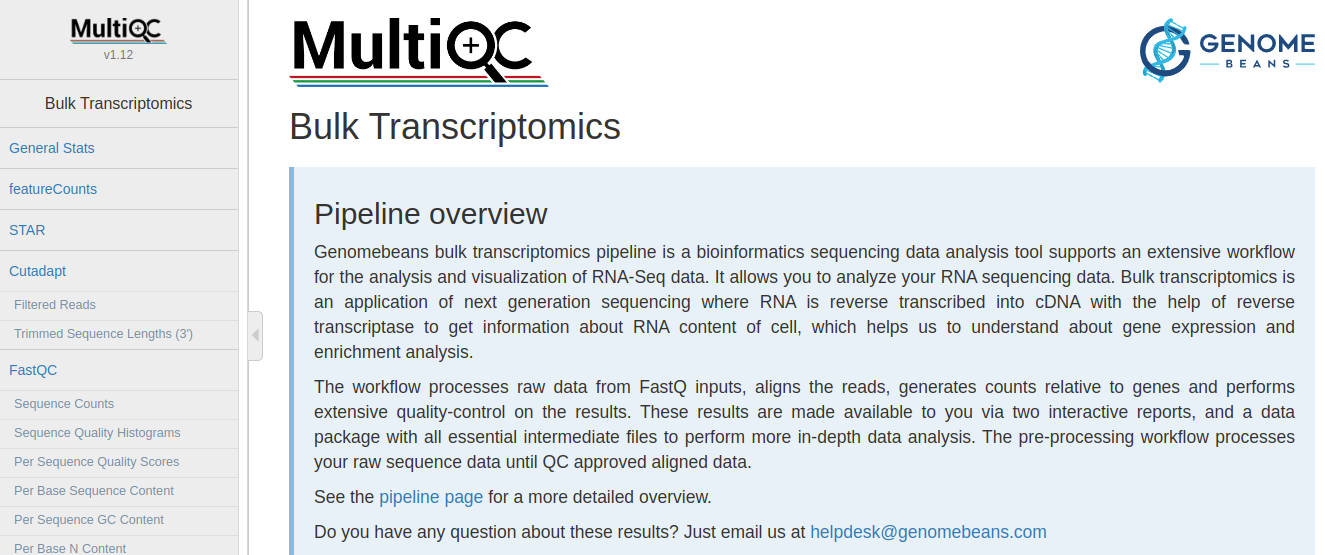
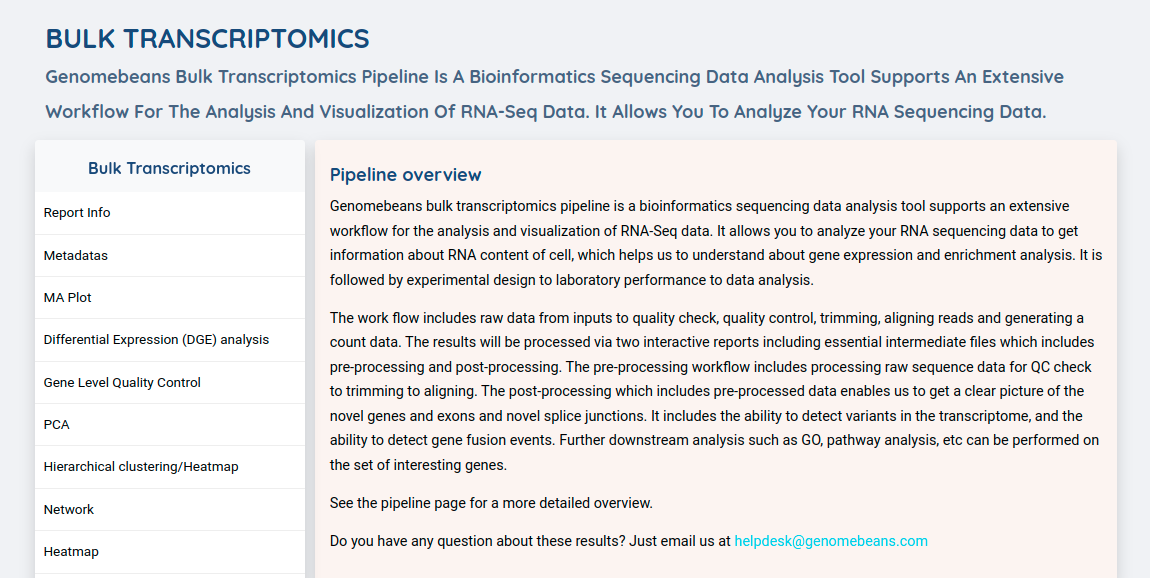
The work flow includes raw fastq files as input which are processed for quality control, aligning reads and gene count. The results are made available to you via two interactive reports including essential intermediate files for deep insight which includes pre-processing and post-processing.
The pre-processing workflow includes processing raw sequence data from quality check to gene count. The post-processing includes pre-processed data to get clear picture of the normalized data via statistical approach to get information about biological meaning.

Raw data is generated from laboratory is used as sample for sequencing data analysis.

The raw data is converted into .fastq format for its quality check and is tested on different parameters to identify sequence purity.

On the basis of sequence quality it is trimmed and adapter or any mismatch pair are removed.

Index is prepared with reference file that holds information about gene structure.

The sample is mapped to reference based on the index generated, to identify the reads mapped to a given gene in the reference.

Unsorted aligned BAM sample files thus generated are further sorted for gene counts.

The gene structure information and sequence alignment information are used for counting genes.

It searches a given directory for analysis logs and compiles a HTML report.
Count matrix from pre processing are used for further analysis to generate high quality matrix count give the number of reads which could be uniquely aligned.

Statistical analysis is performed on the gene counts to obtain differentially expressed genes. An average expression is identified from the various dimensionality generated reports. Differential gene expression is important to understand the biological differences between healthy and diseased sample.

It’s a method to identify classes of genes or proteins that are over-represented in a large set of genes or proteins, and may have an association with disease phenotypes which includes gene ontology and KEGG.

A protein network analysis graph is generated based on the top 25 most variant gene. The network can represents the associative or dissociate properties of these genes with respect to the underlying disease.
A compiled report of the graphs, and tables is generated which includes both pre-processing and post-processing results.
The questions researchers actually Google before running their first bulk-transcriptomics analysis.
Not even close. Upload your raw FASTQ files and the platform takes it from there. QC, trimming, alignment, gene counting, normalization all automated. No terminal. No scripts. No prior bioinformatics knowledge needed at all.
Most runs wrap up within hours of submission. A standard 6-sample human RNA-seq experiment is typically done the same day. Your dashboard updates live the whole time so you're never left wondering where things stand.
Bulk RNA-seq measures average gene expression across your whole sample. It is fast, affordable, and perfect for most DEG studies. Single-cell RNA-seq gives you cell-level resolution but costs significantly more and generates far larger datasets. Although it is costlier and more complex, it resolves cell-type-specific and subpopulation-level differences, rare sub-population variation, and cancer cell stratification.
A full DEG table with log2 fold change and adjusted p-values. Volcano plots. Heatmaps. PCA plots. GO enrichment and KEGG pathway maps. All packed into one interactive HTML report you can open in any browser and share with your team instantly.
Analysis time depends on the size of your dataset, number of samples, and selected workflow. Most projects are processed automatically, and progress can be monitored directly from your dashboard.
100% private. You own everything you upload. It is never shared. Never sold. Results are securely archived for 90 days then permanently deleted from our servers. No exceptions. No fine print.
