


Accurate variant calling in NGS data is a critical step upon which virtually all downstream analysis and interpretation processes rely. Germline analysis in family trios and somatic analysis of tumor-normal pairs.
Variant calling is a crucial step in the analysis of germline data, particularly in the field of genetics and germlines. It involves identifying and cataloging differences (variants) in the genetic material (DNA or RNA) when comparing it to a reference genome or another sample. These variants can include single nucleotide changes (SNPs), insertions, deletions, and structural variations.
Variant calling has become the basis of downstream analysis for all the genetically predisposed diseases, like diabetes, downs syndrome, autism, arthritis and to much extent cancer.
Variant analysis steps include a robust NGS alignment pipeline and pre-processing pipeline, variant calling, filtering the variants and manual review.
Variants such as deletions or insertions can be called by any given package but structural and copy number variants should be analyzed by multiple softwares.
We at genomebeans thrive to provide you with robust and reliable analysis on which you can carry forward your downstream analysis.

Raw data is generated from laboratory is used as sample for sequencing data analysis.

The raw data is converted into .fastq format for its quality check and is tested on different parameters to identify sequence purity.

On the basis of sequence quality it is trimmed and adapter or any mismatch pair are removed.
Index is prepared with reference file that holds information about gene structure.

The sample is mapped to reference based on the index generated, to identify the reads mapped to a given gene in the reference.

Unsorted aligned BAM sample files thus generated are further sorted for gene counts.

We use the GATK HaplotypeCaller to perform variant calling. The HaplotypeCaller is capable of calling SNPs and indels simultaneously via local de-novo assembly of haplotypes in an active region.

This step separates SNPs and Indels so they can be processed and analyzed independently. Various hard filters are applied to further filter the variants for he highest quality and prep for annotation.

Used funcotator tool for GATK that uses pre-packaged vcf database from GRCh38 and hg19. Depending on the need we can use SNPeff, gnomad, etc to annotate the variants.

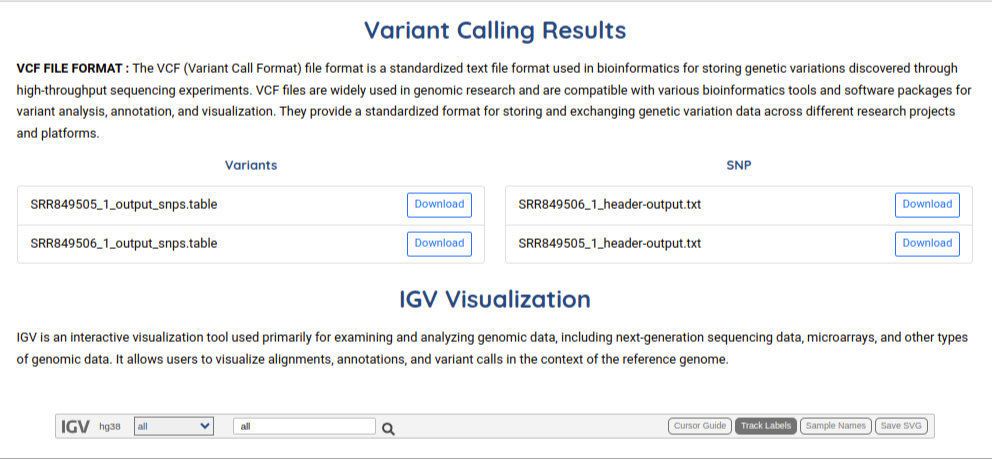
We use IGV for visualization.
The questions researchers actually Google before running their first variant calling experiment.
Variant calling finds the differences between a sequenced genome and a reference, including SNPs, insertions, deletions, and structural changes. These are the genetic basis of inherited disease, cancer mutations, and population diversity. Every downstream analysis starts here. Get this wrong and everything built on top of it is unreliable.
Germline variants are inherited, present in every cell, and passed to offspring. Somatic variants arise after conception, typically in tumor cells, and are found by comparing tumor and normal tissue from the same patient or a panel of normals. The tools used for each are completely different. GenomeBeans handles both in the same automated pipeline.
Yes. Both whole genome sequencing and whole exome sequencing inputs are fully supported. Upload your raw FASTQ files and the platform automatically selects the right alignment and variant calling parameters. No manual configuration needed.
Variants are annotated using multiple reference databases including dbNSFP, ClinVar, dbSNP, dbscSNV, gnomAD, and the 1000 Genomes Project. Together, these resources provide information on known variants, population allele frequencies, clinical significance, functional predictions, and splice-site impact. This comprehensive annotation framework helps prioritize potentially pathogenic variants and distinguish rare disease-associated variants from common benign polymorphisms.
A fully annotated VCF file, hard-filtered SNP and indel tables, functional impact annotations, population frequency data, and IGV visualizations — all packed into one interactive HTML report you can open in any browser and share instantly.
100% private. You own everything you upload. It is never shared. Never sold. Results are securely archived for 90 days then permanently deleted from our servers. No exceptions. No fine print.
