


Beyond SNVs: Why Structural Variants and CNVs Are the Missing Piece in Many Genetic Diagnoses
When a genetic test comes back negative, the obvious assumption is:
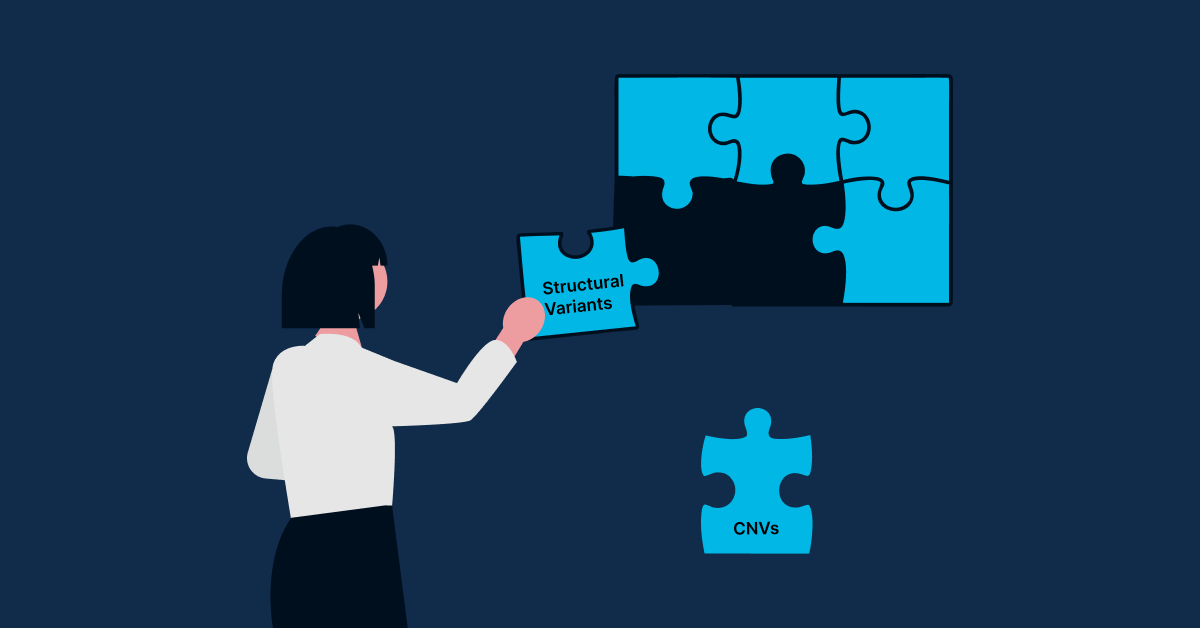
There was no disease-causing variant.
But a negative result does not always mean there is no genetic explanation.
Sometimes, the problem is what the analysis was designed to detect.
Most standard variant-calling workflows focus heavily on single-nucleotide variants (SNVs) and small insertions/deletions (indels). These variants are important, but they represent only part of the genomic picture.
Other changes including copy-number variants (CNVs) and structural variants (SVs) can affect genes, exons, regulatory regions, and chromosome structure.
For some unresolved cases, that missing layer of variation may be important.
The Genome Is More Than Single-Base Changes
Think of the genome as a large instruction manual.
An SNV changes a single letter.
An indel adds or removes a small sequence.
A structural variant can change a much larger section of the genome.
Structural variants can include:
- Deletions
- Duplications
- Insertions
- Inversions
- Translocations
CNVs are genomic regions where the number of copies differs from what is expected, most commonly through deletions or duplications.
These changes can affect gene dosage, disrupt genes, or alter genomic architecture.
The difference can be as simple as having an extra copy of a gene. A duplication of the PMP22 gene, for instance, increases gene dosage and is associated with Charcot-Marie-Tooth disease type 1A (CMT1A). Here, the important finding is not a single altered DNA letter, but a change in the number of copies.
This is not simply a theoretical concern. ACMG and ClinGen have established professional standards for interpreting and reporting constitutional CNVs, reflecting their clinical importance and the need for consistent evidence-based classification.
Why Can Structural Variants Be Difficult to Detect?
This is where sequencing technology and bioinformatics become important.
Short-read sequencing is highly effective for detecting SNVs and many small indels. But larger or more complex genomic changes can be harder to identify, particularly in repetitive or highly similar genomic regions.
Structural variant analysis may rely on multiple signals, including:
- Abnormal read-pair orientation
- Split or soft-clipped reads
- Changes in read depth
- Local assembly evidence
The key point is not that short-read sequencing cannot detect structural variants.
Rather, detection depends on the sequencing assay, genomic region, variant type, and analytical method.
And sometimes the change isn't in how much DNA is present, but in how that DNA is arranged. An inversion involving the F8 gene can disrupt its normal structure and cause hemophilia A. The sequence is not simply missing or duplicated a section of DNA has been rearranged into the opposite orientation.
ACMG's technical standards for clinical NGS also emphasize appropriate validation, quality monitoring, and interpretation of sequencing results as technologies and informatics continue to evolve.
The Deletion an SNV-Focused Workflow May Miss
Imagine a patient with a strong phenotype suggesting a genetic disorder.
Sequencing is performed.
The analysis finds:
No pathogenic SNV.
No convincing small indel.
The case may initially appear negative.
But what if an exon is deleted?
Or a larger genomic segment is duplicated?
Or a structural rearrangement disrupts the gene?
An SNV/indel-focused workflow may not provide the complete answer because the causal event belongs to a different variant class.
This is why a negative result should not automatically be interpreted as “no genetic cause exists.”
A better question is:
Which variant types were actually assessed, and how well were they assessed?
Variant Calling Is Only the Beginning
Finding a variant is not the same as understanding it.
A robust workflow moves through:
Detection → Quality Assessment → Annotation → Interpretation → Clinical Context
Once candidate variants are identified, variant annotation helps connect them with genes, transcripts, population databases, disease associations, and functional evidence.
As datasets grow, however, manual annotation can become a bottleneck.
For more on this challenge, see our guide on manual variant annotation and how automation is changing the workflow.
For CNVs and other variants, researchers still need to determine:
- Which genes or exons are affected?
- Is gene dosage likely to change?
- Is the variant associated with a known disease mechanism?
- What evidence supports its clinical significance?
- Does it match the patient's phenotype?
Detection is only the first step.
What About Exome Sequencing?
Structural variant analysis is not limited to whole-genome sequencing.
Researchers have developed approaches for detecting some structural changes from WES data, although exome sequencing was primarily designed to capture coding regions and may have limitations for larger or complex genomic events.
Therefore, when an exome result is negative, it is important to understand what the assay and analysis pipeline were actually capable of detecting.
For more context on turning WES data into meaningful findings, see our article on why Whole Exome Sequencing reports can miss the point.
When Should You Look Beyond SNVs?
A broader variant analysis can be particularly valuable when:
The phenotype strongly suggests a genetic disorder but SNV/indel analysis is negative.
A known disease mechanism involves gene dosage or copy-number changes.
The genomic region is repetitive or structurally complex.
There is suspicion of an exon-level or multi-exon deletion or duplication.
Previous testing had limited variant-detection capabilities.
The goal isn't to replace SNV analysis.
It's to avoid treating one variant class as the entire genomic answer.
What Does the Research Say?
The importance of structured variant interpretation is reflected in established clinical guidance.
ACMG and ClinGen provide technical standards for constitutional CNV interpretation and reporting, while ACMG/AMP guidelines provide a widely used framework for interpreting sequence variants based on multiple lines of evidence.
Together, these standards reinforce an important principle:
Finding a variant is not the same as understanding what it means.
The Takeaway
Genetic variation is bigger than SNVs.
SNVs matter. Indels matter. But so do deletions, duplications, inversions, translocations, and other structural changes.
For some unresolved cases, the missing explanation may not be another single-base variant.
It may be a change in the structure or copy number of the genome itself.
That is why CNV and structural variant analysis can be an important part of a broader genomic investigation when supported by the assay and biological question.
The more complete the variant analysis, the more complete the picture of the genome.
At GenomeBeans, our Variant Calling analysis workflow helps researchers analyze genomic variants through structured calling, filtering, annotation, visualization, and appropriate CNV/structural variant analysis.
Because sometimes the variant you're looking for isn't a single letter.
It's a structural change hiding in the bigger picture.
Popular Post
-
05 October 2026
Bioinformatics vs Data Science: What’s Actually Different?

-
28 September 2026
How Scientists Use Bulk Transcriptomics to Understand What a Drug Does Inside Cells

-
21 September 2026
Inside a Brain, Cell by Cell: What Alzheimer's Research Looks Like at Single-Cell Resolution

-
14 September 2026
When Mitochondria Fail: How Variant Calling Supports Mitochondrial Disease Research

-
07 September 2026
From Bacteria to Biomarkers: How the Gut Microbiome Is Becoming a Clinical Tool