

Bioinformatics Tools Are Everywhere. Knowing Which One to Use Is the Hard Part
Finding bioinformatics tools is easy. Knowing which one fits your research is the real challenge.
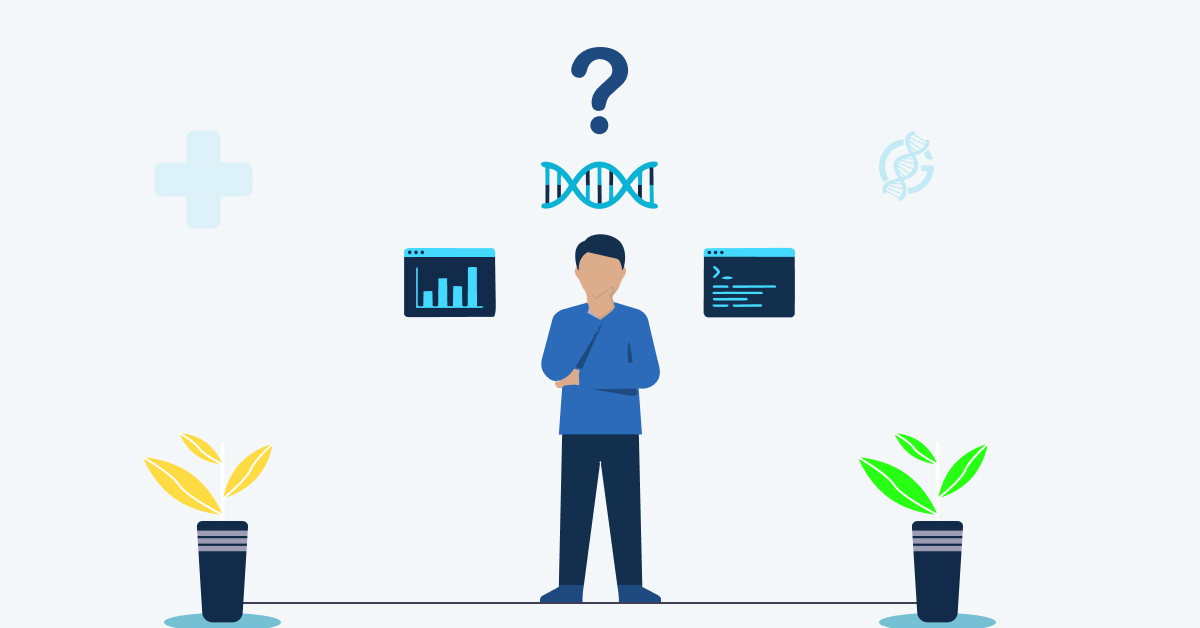
A quick search can reveal dozens of software options, online platforms, and analysis pipelines. Some focus on gene expression, others on genetic variants, and many handle specific stages of sequencing data analysis.
With so many choices, researchers can spend more time comparing tools than analyzing data. The solution is to understand your research requirements before choosing a tool.
Start With the Research Question
Before selecting software, identify what you want to discover. Are you comparing gene expression, investigating genetic variants, studying microbial communities, or exploring individual cell populations?
Each question requires a different analytical approach. Bulk RNA-seq analysis, for example, helps compare gene expression across samples, while single-cell transcriptomics explores differences between individual cells.
Start with the biological question, then identify the tools needed to answer it.
Which Bioinformatics Workflow Fits Your Research?
| Research goal | Suitable workflow | What it helps analyze |
|---|---|---|
| Compare gene expression | Bulk transcriptomics | Differentially expressed genes and pathways |
| Explore individual cells | Single-cell transcriptomics | Cell populations and cellular heterogeneity |
| Identify genetic differences | Variant calling | SNPs, small insertions and deletions, and variant annotations |
| Study microbial communities | Metagenomics | Microbial composition and functional potential |
The right workflow depends on your data, research question, and expected results. Explore the GenomeBeans bulk transcriptomics pipeline, single-cell transcriptomics, and variant calling to learn more about these analysis approaches.
Popular Does Not Always Mean Suitable
A widely used tool may still be unsuitable for your project. Popularity can help you discover established software, but it does not guarantee that the tool meets your requirements.
Before choosing, consider four factors:
- Data compatibility: Can it process your file formats, sequencing data, and dataset size?
- Computing resources: Will it run efficiently with your available memory, processing power, and infrastructure?
- Reproducibility: Can you document software versions, reference databases, and parameters to repeat the analysis?
- Maintenance and support: Are documentation, troubleshooting guidance, and software updates available?
These factors can make a significant difference to the time and effort required to complete an analysis.
Think About the Complete Analysis Pipeline
Bioinformatics analysis rarely ends with a single tool. An NGS workflow may include quality control, preprocessing, alignment or quantification, statistical analysis, and biological interpretation.
For example, bulk RNA-seq analysis may require gene expression quantification, differential expression analysis, and pathway enrichment. Each stage depends on suitable inputs and appropriate settings.
Tools must also work together. Incompatible output formats or inconsistent parameters can create additional processing steps and make results harder to reproduce.
A well-planned bioinformatics pipeline keeps these stages organized and makes the analysis easier to review. For more insights into the field, read Bioinformatics vs. Data Science: What's Actually Different?
Individual Tools or an Automated Pipeline?
Individual tools offer flexibility when a project requires specialized methods or detailed control. However, managing several tools manually can involve software installation, dependency management, file conversion, and repeated troubleshooting.
An automated pipeline can organize supported analysis steps into a more consistent workflow and reduce repetitive work. For researchers who prefer a simpler interface, no-code bioinformatics can make supported analysis workflows more accessible without requiring extensive programming knowledge.
Custom workflows may suit specialized projects, while standardized pipelines can be practical for routine analyses with established requirements.
Automation does not eliminate the need for quality checks or scientific judgment. Researchers should understand the methods used and review the resulting outputs.
Can a No-Code Bioinformatics Tool Help?
Running bioinformatics software locally may require technical expertise, computing resources, and ongoing maintenance. A no-code bioinformatics tool offers an alternative by allowing users to access supported analysis workflows through a graphical interface rather than writing code for every step.
Depending on the platform, researchers may be able to upload sequencing data, select a suitable pipeline, run analyses, and review reports through an online environment.
GenomeBeans provides online bioinformatics workflows for supported genomics and transcriptomics applications. Researchers can explore its bulk transcriptomics pipeline to see whether it fits their gene expression analysis requirements.
Before choosing a platform, check its supported data formats, analytical methods, data security practices, and output requirements. A no-code interface can simplify access to analysis, but selecting the appropriate workflow and reviewing the results remain essential.
Choose Tools That Fit Your Research
There is no single bioinformatics tool that works best for every project. The right choice depends on your research question, data type, computing resources, and required outputs.
Define the objective, check compatibility, consider reproducibility, and evaluate how each tool fits into the complete pipeline.
The goal is not to use the most tools. It is to choose the right tools for reliable, meaningful analysis.
Explore the GenomeBeans bioinformatics platform to learn more about its online analysis workflows for supported genomics and transcriptomics applications.
Popular Post
-
05 October 2026
Bioinformatics vs Data Science: What’s Actually Different?
-
28 September 2026
How Scientists Use Bulk Transcriptomics to Understand What a Drug Does Inside Cells

-
21 September 2026
Inside a Brain, Cell by Cell: What Alzheimer's Research Looks Like at Single-Cell Resolution

-
14 September 2026
When Mitochondria Fail: How Variant Calling Supports Mitochondrial Disease Research
-
07 September 2026
From Bacteria to Biomarkers: How the Gut Microbiome Is Becoming a Clinical Tool