
Same Diagnosis, Different Outcomes: How DNA Sequencing Is Changing Cancer Treatment
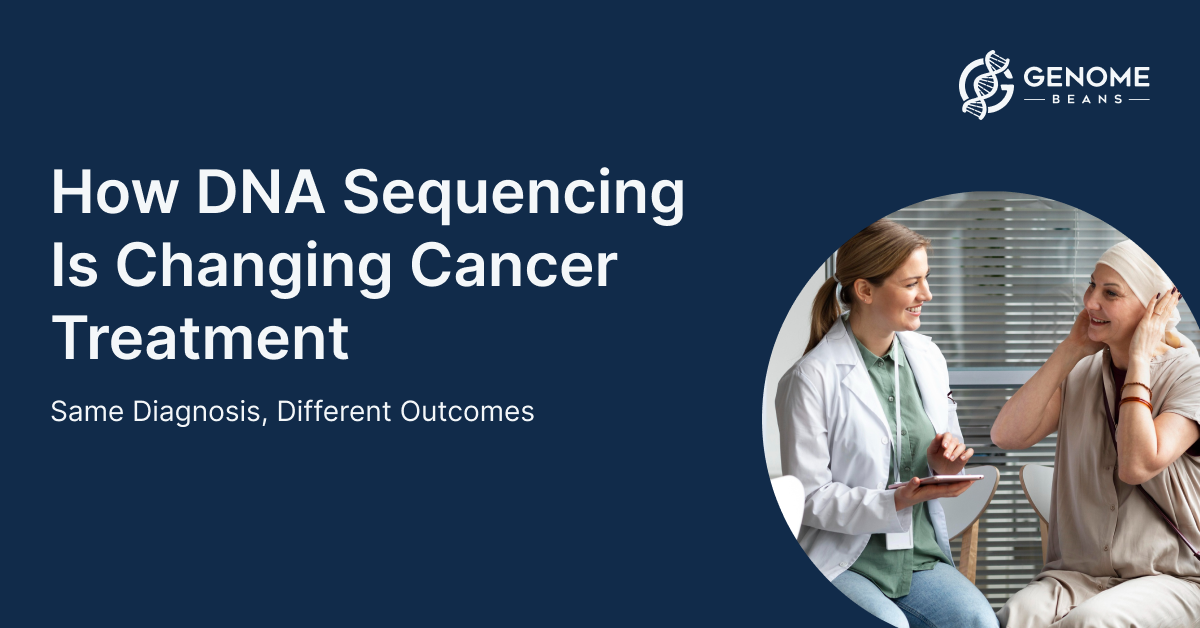
Imagine two patients diagnosed with the same lung cancer. Same stage, same diagnosis. One responds well to treatment. The other doesn’t, and for decades, doctors had no way of knowing why until it was too late.
For the longest time, cancer treatment worked like a blunt instrument: surgery, chemotherapy, radiation, applied broadly and hoped for the best. That’s changing, because scientists learned to read the instruction manual hidden inside every tumor.
Why Cancer Is Really a Disease of DNA
Cancer doesn’t start in an organ; it originates in a single cell whose DNA has mutated. DNA acts as an instruction manual for a cell’s day to day processes. This manual consists of a sequence of letters A, T, G and C (representing nucleotide bases, Adenine, Thymine, Guanine and Cytosine). The arrangement of this sequence and the chapters a cell chooses to read are unique to each individual.
A cell multiplies by dividing! When small errors (like skipping, misplacement or adding one of those letters) occur randomly during re-printing that manual while making a new cell from an old one, it leads to what we call “mutations.” On unfortunate rare occasions, when this error occurs in the “cell division” chapter and escapes our immunity’s surveillance, the next read of this chapter can lead to uncontrollable new cells. These aren’t healthy, functioning cells, but they are programmed to divide and consume healthy neighbouring cells’ resources, thus causing cancers.
So, two tumors can share the same diagnosis and still be driven by entirely different mutations. That difference is exactly what decides whether a treatment will work.
What DNA Sequencing Actually Does
Reading a person’s whole DNA (or genome) once took decades and billions of dollars. The Human Genome Project, took thirteen years for single human genome. Today, Next-Generation Sequencing technology (NGS) can do the same job in hours, at a fraction of the cost through modern bioinformatics services.
NGS is used to read the DNA sequence in tumor cells and compare it against the patient’s own healthy DNA. The mutations unique to cancer cells’ DNA form a molecular fingerprint that reveals what’s actually driving the tumor’s growth.
Matching the Fingerprint to Treatment
Once doctors know a tumor’s key mutations, they can select therapies designed for those exact changes, called targeted therapies.
For example, DNA (say, manual) of some breast cancer patients carries a mutation (here, extra copy) of a gene (say, chapter) called HER2. These patients respond well to trastuzumab drugs (like Herceptin), which blocks the protein product of the HER2 gene directly. Patients without this mutation face the drug’s side effects with no improvement in health.
Sequencing supports Immunotherapy – treatment that activates a patient’s own immune system against cancer. One measure, tumor mutational burden (TMB), simply counts how many mutations a tumor carries; tumours with more mutations tend to look more like a “suspect” to the immune system, making them more likely to respond to drugs called “checkpoint inhibitors.”
“Microsatellite instability, a marker (say, red flag) in tumor DNA, helped identify patients suited to a drug called pembrolizumab. This drug was approved in 2017 across multiple cancer types based on this shared feature, regardless of where the cancer started.
Does Every Patient Benefit?
Not always. Sequencing is valuable when it finds a mutation with a matched, evidence-backed therapy. For certain types of cancers like breast, lung, and colorectal, this is becoming a standard practice. Sadly, for others, options remain limited, and results may mainly guide eligibility for somatic variant calling and clinical research.
Access matters too. Comprehensive sequencing isn’t available everywhere; interpreting results requires specialist expertise; and cost and infrastructure remain barriers to efficient patient care.
What’s Coming Next
Liquid biopsy detects tumor DNA in a blood sample. This method might allow earlier detection and easier treatment monitoring without repeated tissue biopsies.
Machine learning is helping researchers interpret genomic data faster, spotting patterns across thousands of profiles.
Multi-omics approaches are beginning to combine DNA with RNA, protein, and other data for a fuller picture of tumor biology.
Even with promising technology, cancer remains a formidable challenge, resisting and evolving. But understanding cancer at the molecular level is steadily reshaping prevention, treatment, and patients’ quality of life.
Key Takeaways
- Cancer is a disease of DNA mutations – even tumours with the same name can be driven by very different changes.
- Sequencing a tumor’s DNA reveals which mutations are driving it, helping doctors match patients to therapies most likely to work.
- Targeted therapies and immunotherapy selection both depend on genomic markers found through sequencing.
- Sequencing is most useful when it finds an actionable mutation – results aren’t always immediately useful for every patient.
- Liquid biopsy, AI-assisted analysis, and multi-omics are expanding what’s possible next.
Popular Post
-
19 October 2026
Can No-Code Bioinformatics Replace Coding? Here’s Where It Helps
-
12 October 2026
Bioinformatics Tools Are Everywhere. Knowing Which One to Use Is the Hard Part
-
05 October 2026
Bioinformatics vs Data Science: What’s Actually Different?
-
28 September 2026
How Scientists Use Bulk Transcriptomics to Understand What a Drug Does Inside Cells
-
21 September 2026
Inside a Brain, Cell by Cell: What Alzheimer's Research Looks Like at Single-Cell Resolution