


Demystifying Immunomics: A Researcher’s Guide to TCR and BCR Repertoire Profiling

A researcher dedicates months to carefully design experiments to probe immune responses. Now, terabytes of raw sequencing data are waiting to be analyzed. The goal of identifying specific phenotypes or tracking immune cell dynamics is challenging, and the computational analysis required to extract these insights can feel tricky.
This is where our immunomics analysis comes into play. It transforms raw data into actionable biological understanding without demanding specialized coding skills. The following guide breaks down the core concepts of immune repertoire profiling, focusing on T-cell receptors (TCRs) and B-cell receptors (BCRs).
What is Immunomics?
Immunomics is the study of the immunome, encompassing the genes, proteins, and molecular interactions that define the immune system’s functional states. Instead of analyzing isolated immune markers, it provides a holistic view of entire immune cell populations and their functional states.
At its core, an Immunomics pipeline characterizes the immune repertoire, i.e., the full diversity of TCRs and BCRs. The adaptive immune system relies on this diversity to recognize pathogens; profiling it offers a molecular snapshot of an individual’s immune history, vaccine efficacy, and disease progression.
TCR vs. BCR Repertoire: Structural Differences
TCRs and BCRs enable highly specific antigen recognition and they have distinct architectures and mechanisms:
- T-Cell Receptors (TCRs): Typically membrane-bound heterodimers composed of an alpha ($\alpha$) and a beta ($\beta$) chain. Most TCRs recognize processed peptide antigens presented by MHC molecules on antigen-presenting cells, though subsets such as $\gamma\delta$ T cells and NKT cells can recognize antigens independently of classical MHC presentation.
- B-Cell Receptors (BCRs): Membrane-bound antibodies shaped like a “Y”, comprising two identical heavy chains and two identical light chains. BCRs directly recognize both conformational and linear epitopes on intact antigens without needing MHC presentation.
How Immune Repertoire Diversity is Generated
The astronomical diversity of TCRs and BCRs is driven by V(D)J recombination. This genetic mechanism randomly rearranges distinct segments to assemble a functional receptor:
- V (Variable) Segment: Codes for the initial part of the antigen-binding site.
- D (Diversity) Segment: Found in heavy chains and TCR beta/delta chains, contributing additional sequence diversity at the nucleotide level during recombination.
- J (Joining) Segment: Links the variable domains to the constant region.
- Junctional Diversity: Random N-nucleotide additions inserted directly between these segments during the recombination process.
During this process, random nucleotide additions occur at the junctions to create junctional diversity. The most hypervariable region arising from this junction is the Complementarity Determining Region 3 (CDR3). Because the CDR3 loop directly dictates antigen specificity, sequencing this region is the cornerstone of immune repertoire analysis.
Strategic Applications in Biomedical Research
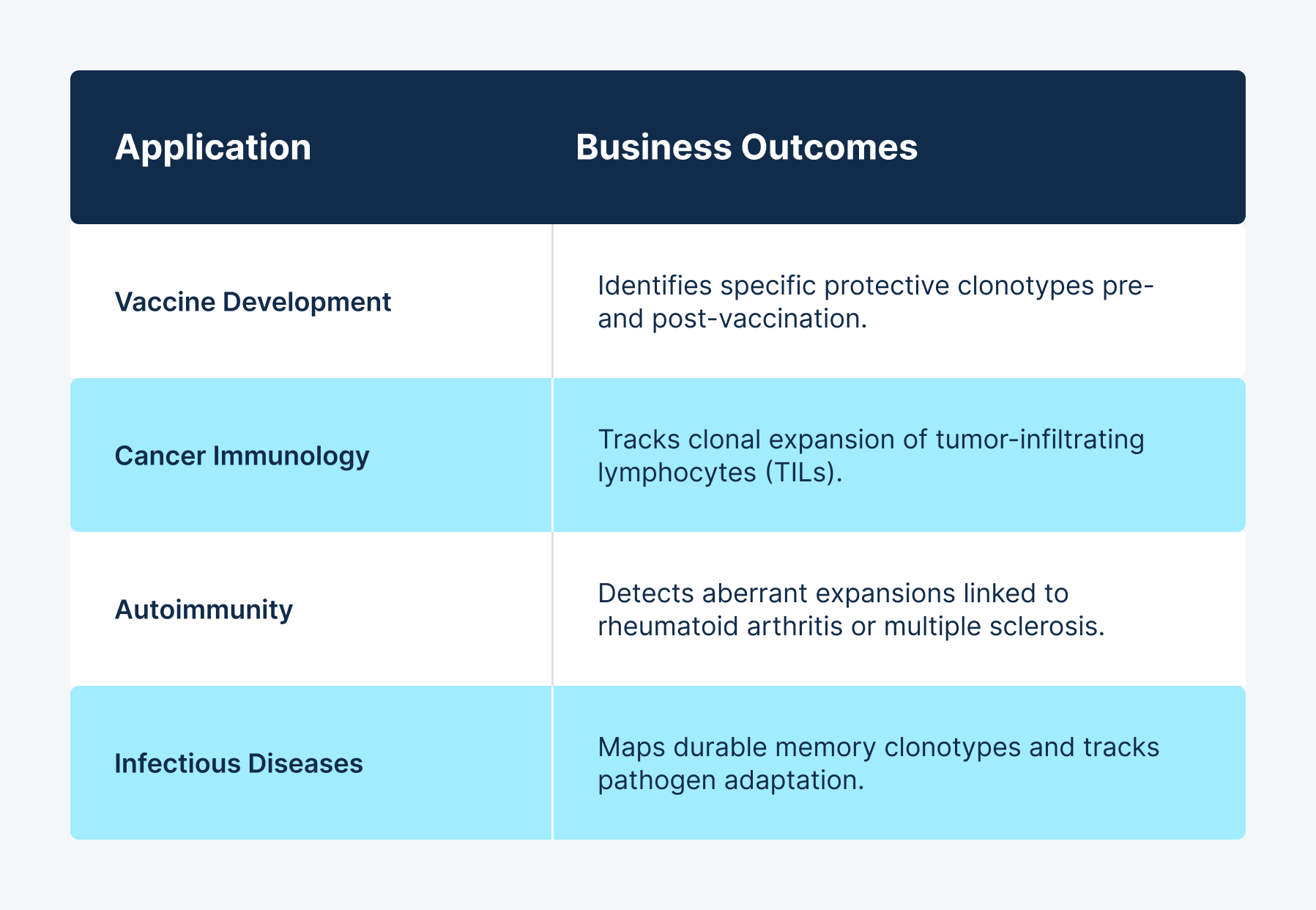
High-throughput NGS sequences millions of individual receptor reads, which following computational processing, enables mapping of clone frequencies across several critical fields:
Key Metrics in Bioinformatic Interpretation
Accurately interpreting immunomics data requires monitoring five primary metrics:
- Diversity Indices: Metrics like Shannon entropy or the Simpson index quantify the overall diversity of the repertoire by accounting for both the number of unique clonotypes and their relative abundances.
- Clonal Expansion: Tracks the frequency of specific clonotypes reacting to an antigenic stimulus.
- Public Clonotypes: Identifies shared TCR or BCR sequences across different individuals to find conserved immune responses.
- V(D)J Gene Usage: Evaluates biases or preferences in gene segment selection during recombination.
- Data Normalization: Adjusts for variations in sequencing depth to allow accurate sample-to-sample comparisons.
Accelerate Your Immunomics Research
Processing millions of sequencing reads frequently creates a bioinformatic bottleneck. If you are spending more time troubleshooting command-line scripts than interpreting biological findings, you might ask: is bioinformatics just about coding? Fortunately, automated pipelines offer a scalable alternative.
Standardized cloud platforms handle the computational heavy lifting, yielding publication-ready reports while letting you focus entirely on the science.
Transform Your Raw Sequencing Data Into Discovery
Don’t let complex bioinformatic pipelines stall your research momentum. Upload your raw NGS data to GenomeBeans and receive fully analyzed, publication-ready immunomics reports in hours, with zero coding required.
Ready to accelerate your immune profiling?
Contact our team to discuss your project, request a demo, or submit your first dataset for automated analysis today.
Popular Post
-
07 September 2026
From Bacteria to Biomarkers: How the Gut Microbiome Is Becoming a Clinical Tool

-
04 September 2026
Beyond Gut Bacteria: How Metagenomics Is Decoding the Human Microbiome

-
26 August 2026
Beyond SNVs: Why Structural Variants and CNVs Are the Missing Piece in Many Genetic Diagnoses

-
17 August 2026
Why Biotech Startups Should Outsource Bioinformatics: ROI, Speed & Scalability

-
10 August 2026
Manual Variant Annotation Is Slowing Your Lab Down - Here's What's Replacing It