


Choosing the Right Bioinformatics Platform: Infrastructure, Architecture, and Real Cost Breakdown
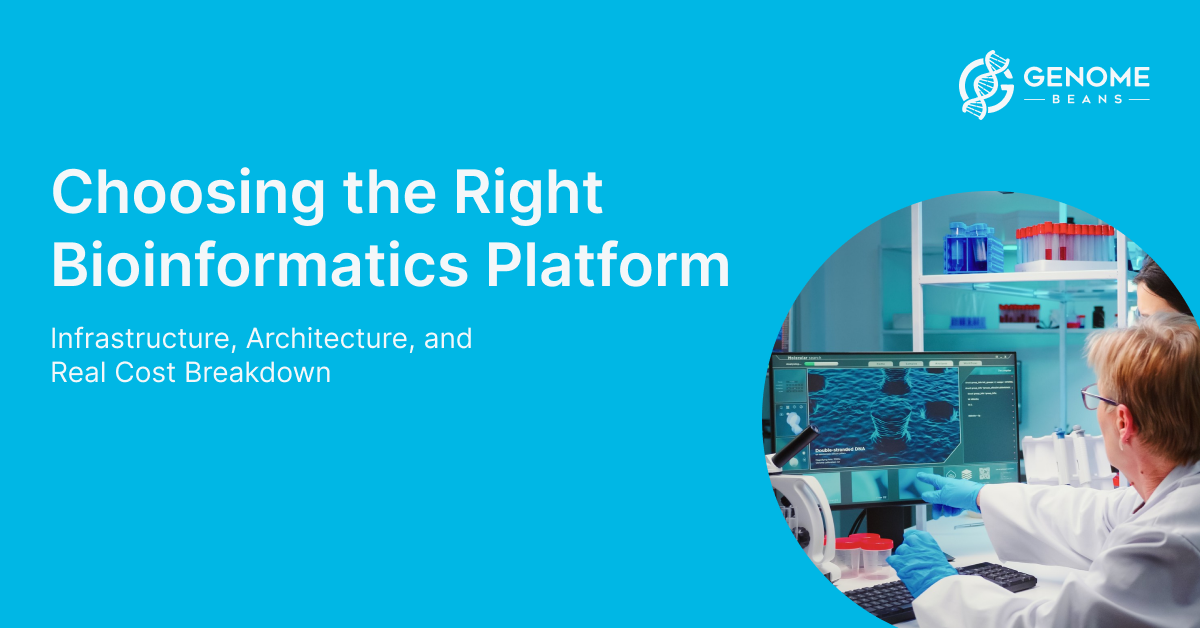
Finalizing a bioinformatics platform for your lab requires looking past marketing buzzwords and analyzing the cold, hard numbers of data infrastructure. One oversight and you face sudden cloud compute invoices, massive upfront license expenses, or hidden maintenance overheads that drain your laboratory’s grant.
To choose the right digital architecture for your genomic data, you must evaluate three core pillars: infrastructure footprint, billing model, and the technical capacity your team can realistically support.
Note: GenomeBeans is included in this comparison as one of several active platforms in this space. We’ve aimed to apply the same scrutiny to our own model as to the others below.
Architectural & Financial Blueprint Matrix
| Platform | Deployment Architecture | Billing Model | Real-World Financial Impact |
|---|---|---|---|
| Galaxy | Public Academic Cloud / Shared Servers | $0 (Free) | Zero software cost; indirect cost is time spent waiting in public compute queues. |
| GenomeBeans | Secure Cloud Pipeline Platform | Per-Experiment / Checkout Model | Predictable cost per sample/run; best suited to project-based volumes rather than continuous high-throughput operations. |
| Qiagen CLC | On-Premise Workstation / Desktop App | Fixed Annual Subscription (Per-seat license) | High upfront cost; requires in-house IT support for hardware upkeep, though cost-effective for sustained high-volume local processing. |
| DNAStar Lasergene | On-Premise Workstation / Desktop App | Fixed Annual Subscription (Academic/Commercial tiers) | Predictable yearly budgeting; includes updates and support, but performance is capped by local hardware. |
| Illumina ICA | Cloud-Native Environment (AWS/Azure) | Consumption-Based iCredits (Per-Gigabase / Per-Hour) | Highly scalable; variable monthly billing tied to compute and storage use, requiring active monitoring. |
| BIOVIA | Enterprise Life Sciences Hybrid Cloud | Custom Enterprise Contracts (Multi-year agreements) | High-end capital expenditure tailored to pharmaceutical PLM scaling. |
Deep Dive: How the Cost Models Actually Work
1. The Consumption-Based Cloud: Illumina ICA
Illumina Connected Analytics (ICA) is built for high-throughput core facilities processing data directly from the sequencer. It runs on iCredits you pay for compute hours (by node size) and storage (per TB/month). DRAGEN pipelines like Map & Align apply volumetric tier pricing per gigabase, meaning your monthly spend scales directly with sequencing output. This is efficient at scale but requires active budget monitoring, since costs are variable rather than fixed.
2. The Fixed-License Desktop Suites: Qiagen CLC & DNAStar Lasergene
For labs that prefer capped annual costs, desktop installations isolate financial risk. Qiagen CLC Genomics Workbench charges a flat per-seat annual fee regardless of sample volume good for predictability, but the upfront cost is real, and hardware maintenance falls on your own IT resources. DNAStar Lasergene follows a similar model with academic discounts; because processing is local, you avoid cloud fees, but you’re bound by your workstation’s own RAM and CPU limits.
3. The Checkout-Driven Automation: GenomeBeans
For research teams and biotech setups that want to avoid the upfront cost of desktop licenses or the variable complexity of full cloud infrastructure, GenomeBeans uses a per-experiment checkout model: upload FASTQ data, set parameters, and pay per analysis run. This gives predictable, project-based cost without hardware overhead. It suits teams with project-based or fluctuating sample volumes particularly well; teams running continuous, very high sample throughput should model per-experiment costs against a subscription or on-prem alternative to see which scales more economically at their specific volume.
4. The Zero-Cost Utility: Galaxy
Galaxy is the baseline of open-source genomics access functionally free, letting students and resource-constrained labs run standard RNA-Seq analysis or alignment tools on shared public infrastructure. The tradeoff is processing latency: jobs queue behind global academic demand, which can be a real constraint for time-sensitive clinical or commercial work.
Regional Infrastructure Realities
Compliance-heavy environments (needing HIPAA, GxP, or strict data residency) often justify the variable cost of cloud platforms like Illumina ICA or the fixed licensing of Qiagen CLC, since validated, auditable pipelines matter more than minimizing per-sample cost. In markets more focused on cost-to-performance efficiency and avoiding idle capital expenditure, on-demand models whether GenomeBeans’ checkout structure or Galaxy for training and low-volume work tended to reduce the burden of maintaining underused local infrastructure.
The Verdict: Which One Should You Deploy?
Ask yourself: who is running the data, and how do you want to pay for compute?
- Galaxy suits students, low-volume pilot studies, or teams with a $0 software budget where processing delays don’t affect timelines.
- GenomeBeans suits teams wanting commercial-grade pipelines without hardware or maintenance overhead, particularly for project-based or variable sample volumes worth benchmarking against a subscription model if your throughput is consistently high.
- Qiagen CLC or DNAStar suit well-funded, independent labs that want direct local control over data processing and can absorb upfront licensing costs.
- Illumina ICA or BIOVIA suit enterprise-scale, high-throughput operations with an engineering team able to manage variable cloud costs and deep automation needs.
Popular Post
-
19 October 2026
Can No-Code Bioinformatics Replace Coding? Here’s Where It Helps
-
12 October 2026
Bioinformatics Tools Are Everywhere. Knowing Which One to Use Is the Hard Part
-
05 October 2026
Bioinformatics vs Data Science: What’s Actually Different?

-
28 September 2026
How Scientists Use Bulk Transcriptomics to Understand What a Drug Does Inside Cells

-
21 September 2026
Inside a Brain, Cell by Cell: What Alzheimer's Research Looks Like at Single-Cell Resolution