


From Mutation to Medicine: How Somatic Exome Sequencing and TMB Analysis Guide Precision Cancer Treatment
Cancer treatment used to begin with a question that was largely anatomical.
Where is the tumor?
Lung. Breast. Colon. Melanoma.
That question still matters. But increasingly, it is no longer the only question that matters.
Two patients can have cancer in the same organ and respond very differently to the same treatment. One tumor may carry a mutation that makes it vulnerable to a targeted therapy. Another may have a completely different genomic profile. One may carry a high number of mutations that could be relevant to immunotherapy research, while another may have a much quieter genome.
This is where precision oncology moves beyond the cancer's location.
It begins with the mutations.
And increasingly, it involves understanding not just which mutations are present, but what the overall mutational landscape of a tumor may reveal about its biology and treatment response.
That is where somatic exome sequencing and tumor mutational burden (TMB) analysis become particularly valuable.
The Tumor Is Not Just a Mass of Abnormal Cells
Cancer develops as genetic changes accumulate in cells. Some alterations help cancer cells grow uncontrollably, avoid cell death, spread to other tissues, or resist treatment.
Many of these changes are acquired during a person's lifetime and exist specifically within the tumor. These are known as somatic mutations.
Germline testing looks at inherited genetic risk.
Somatic testing looks at something different: what has changed inside the cancer itself.
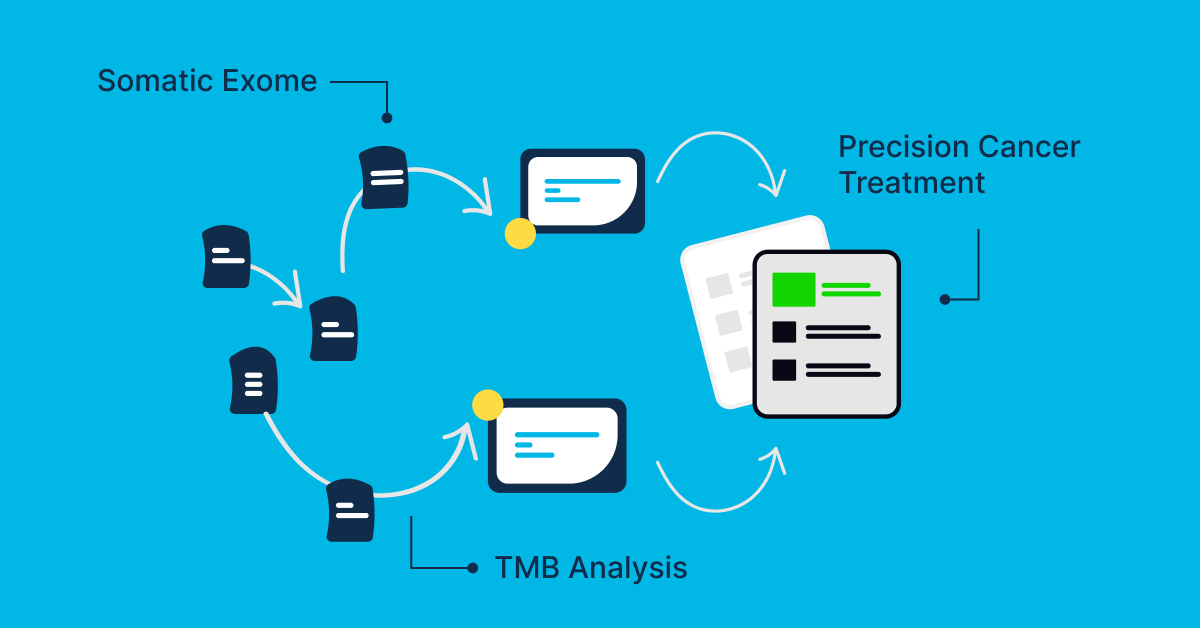
Somatic exome sequencing focuses on the protein-coding regions of the genome, known as exons. Tumor DNA can be analyzed to identify single-nucleotide variants, small insertions and deletions, potentially actionable mutations, and alterations affecting oncogenes or tumor suppressor genes.
When a matched normal sample is available, it can help distinguish acquired somatic mutations from inherited variants.
But finding a mutation is only the beginning.
What Does a Mutation Actually Tell Us?
A mutation is not automatically a driver of cancer, a treatment target, or a clinically meaningful finding.
A tumor may contain thousands of genetic alterations, but only a fraction may have known biological or clinical relevance. Some may be pathogenic. Some may be benign. Others may remain uncertain.
This is why careful variant calling, filtering, annotation, and interpretation are essential.
The goal is not to create a longer list of mutations.
It is to determine which findings actually matter.
From Variant Detection to Biological Meaning
A somatic exome analysis pipeline typically moves through quality control, alignment, variant calling, filtering, annotation, and interpretation.
Each stage influences the next.
Poor-quality data can create unreliable variant calls. Inadequate filtering can produce false positives. Limited annotation can make clinically relevant findings difficult to identify.
A raw VCF file may contain an important biological signal, but it does not explain that signal by itself.
The real value comes from separating high-confidence variants from technical artifacts, filtering inherited variants where appropriate, annotating the remaining alterations, and placing each finding within its biological and clinical context.
Some mutations may have established clinical relevance. Others may be associated with potential treatment options or clinical trials. Some may influence prognosis or treatment response. Many will remain uncertain.
Precision oncology is not about turning every mutation into a treatment recommendation.
It is about separating meaningful signals from genomic noise.
How Many Mutations Does the Tumor Carry?
This is where Tumor Mutational Burden (TMB) adds another layer of information.
TMB is generally expressed as the number of somatic mutations identified per megabase of genomic sequence analyzed. A tumor with a high number of mutations may produce more abnormal proteins, known as neoantigens, which can influence how the immune system recognizes cancer cells.
This has made TMB an important biomarker in immuno-oncology.
However,a TMB score is not a universal prediction of treatment response.
The sequencing platform, genomic territory analyzed, filtering methodology, tumor type, and clinical context all matter.
TMB can be estimated using targeted gene panels or broader approaches such as whole-exome sequencing. Sequencing quality, coverage depth, germline filtering, technical artifacts, and analytical methodology can all influence the final result.
The value of a TMB result depends not only on the number itself, but also on the method behind it.
Why Analyze Mutations and TMB Together?
Somatic mutation analysis and TMB provide different perspectives on the same tumor.
One looks at individual genetic alterations.
The other looks at the broader mutational landscape.
A somatic exome analysis may reveal a potentially actionable driver mutation, an alteration affecting a tumor suppressor gene, or variants associated with treatment response. At the same time, the overall mutational burden may provide additional information relevant to immunotherapy research.
One looks at what changed.
The other looks at the scale of the change.
Together, they create a more complete picture of the tumor's genomic landscape.
From Mutation to Medicine
A genomic report does not prescribe treatment.
It provides evidence.
Treatment decisions still depend on the complete clinical picture, including cancer type, disease stage, previous treatments, patient health, available therapies, other biomarkers, clinical evidence, and guidelines.
A mutation may be associated with a therapy in one cancer type but have limited evidence in another. A high TMB may identify a biomarker category relevant to immunotherapy, but it does not guarantee that a patient will respond.
This is why precision oncology requires more than sequencing.
It requires interpretation.
For researchers and oncology teams, moving from raw sequencing data to meaningful genomic insight requires reliable computational processing, carefully designed pipelines, and clear reporting.
This is where GenomeBeans can help simplify complex NGS data analysis workflows. Through automated bioinformatics services, variant analysis, annotation, and structured reporting, GenomeBeans helps researchers work with complex genomic data without requiring extensive bioinformatics expertise at every stage.
The goal is not simply to generate more genomic data.
It is to generate more usable genomic evidence.
The future of precision oncology will not be built on the assumption that every patient with the same diagnosis needs the same therapy.
It will be built on a more precise understanding of what makes each tumor different.
The journey from mutation to medicine begins with understanding the biology hidden inside the data.
Popular Post
-
19 October 2026
Can No-Code Bioinformatics Replace Coding? Here’s Where It Helps

-
12 October 2026
Bioinformatics Tools Are Everywhere. Knowing Which One to Use Is the Hard Part
-
05 October 2026
Bioinformatics vs Data Science: What’s Actually Different?

-
28 September 2026
How Scientists Use Bulk Transcriptomics to Understand What a Drug Does Inside Cells

-
21 September 2026
Inside a Brain, Cell by Cell: What Alzheimer's Research Looks Like at Single-Cell Resolution