

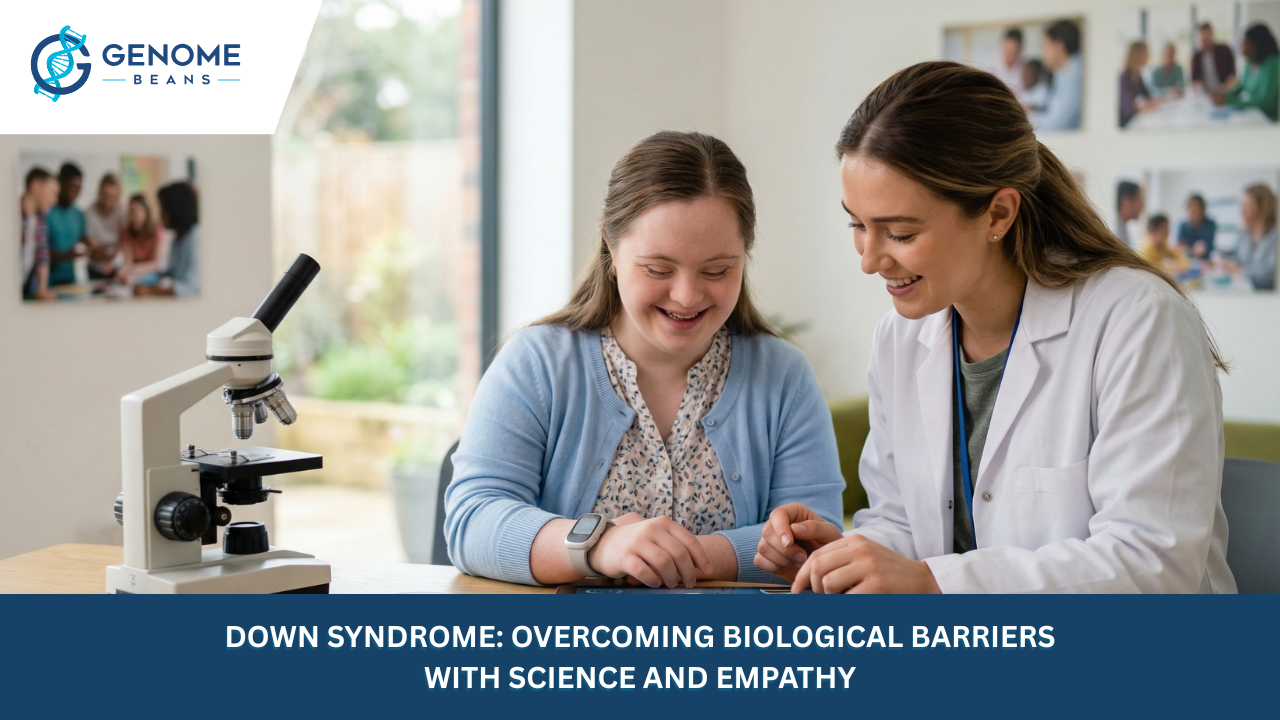
Down Syndrome: Overcoming Biological Barriers With Science and Empathy
” Children with Down syndrome have an extraordinary sweetness of temperament, as if in inheriting an extra chromosome they had acquired a concomitant loss of cruelty and malice.”
– Siddhartha Mukherjee, The Gene: An Intimate History
March 21 marks World Down Syndrome Day, the date itself reflecting Trisomy 21, the triplication of chromosome 21.
What Is Down Syndrome ?
Down syndrome is the most common congenital chromosomal disorder worldwide, occurring in approximately 1 in 900 live births. It arises from the presence of an extra copy of chromosome 21. There are three genetic variants:
• Trisomy 21 (~95%) — every cell carries the extra chromosome due to nondisjunction during meiosis.
• Robertsonian Translocation (~4%) — a segment of chromosome 21 fuses to another acrocentric chromosome, typically chromosome 14. A parent may be a phenotypically normal balanced carrier.
• Mosaic Trisomy 21 (~1–2%) — nondisjunction occurs post-fertilisation during early mitotic division, producing a mixed cell population. Expression is often milder.
Risk Factors And Diagnosis
Maternal age remains the strongest confirmed risk factor. The risk rises from approximately 1 in 1,441 at age 20 to 1 in 84 at age 40. This suggests oocytes arrested in meiosis I from birth accumulate chromosomal errors over decades.
Indicative screening during pregnancy includes first-trimester blood tests, ultrasound markers, and Non-Invasive Prenatal Testing (NIPT). Definitive prenatal diagnosis requires amniocentesis or chorionic villus sampling. After birth, physical examination is followed by karyotyping to confirm the chromosomal profile.
Associated Health Conditions
Down syndrome affects multiple organ systems and requires lifelong clinical monitoring:
• Cardiac — ~40% of newborns have congenital heart disease, commonly septal defects.
• Hearing — 50–90% experience some degree of hearing loss due to recurrent middle ear infections.
• Vision — over 50% develop conditions such as cataracts and strabismus.
• Thyroid — 20–50% are affected by hypothyroidism and coeliac disease.
• Neurological — by age 65, 50–70% develop Alzheimer’s disease which is linked to the overexpression of amyloid precursor protein encoded on chromosome 21.
Life expectancy has improved from approximately 25 years in 1983 to over 60 years today, owed to early intervention and inclusion in mainstream healthcare.
Role Of Early Intervention
There is no pharmacological cure for Trisomy 21, but early and consistent support substantially improves outcomes. A multidisciplinary approach begins in infancy, when neuroplasticity is at its peak. It involves:
• Speech-language therapy — improves communication and language formation.
• Occupational therapy — builds daily independence and fine motor skills.
• Physical therapy — supports muscle tone, posture, and gross motor development.
• Inclusive education — drives cognitive and social growth.
These interventions don’t correct the cause but prepare the child to face the world with confidence. Researchers working to study chromosomal variations and expression patterns can leverage specialized single-cell transcriptomics workflows to map cellular differences at individual cell resolution.
Living With Down Syndrome
In 2020, Zack Gottsagen became the first actor with Down syndrome to present an Academy Award for his lead role in Peanut Butter Falcon, the highest-grossing independent film of 2019.
People with Down syndrome navigate a world that is not built for them, and they do so with genuine curiosity and compassion. Evidence shows inclusive environments with encouraging support systems effectively improve quality-of-life indicators for them.
Noone should be required to be perfect to be given a chance. We have come a long way in diagnosis and treatment. Society has progressed from judgement to sympathy. Now is high time we move from sympathy towards inclusion. If we are still surprised by their ability to fight genetic destiny so gracefully, it says more about our assumptions than their abilities.
Popular Post
-
14 September 2026
When Mitochondria Fail: How Variant Calling Supports Mitochondrial Disease Research
-
07 September 2026
From Bacteria to Biomarkers: How the Gut Microbiome Is Becoming a Clinical Tool
-
04 September 2026
Beyond Gut Bacteria: How Metagenomics Is Decoding the Human Microbiome
-
26 August 2026
Beyond SNVs: Why Structural Variants and CNVs Are the Missing Piece in Many Genetic Diagnoses
-
17 August 2026
Why Biotech Startups Should Outsource Bioinformatics: ROI, Speed & Scalability