


How Scientists Track the Way Your Immune System Actually Responds
When thinking about immune responses, the first thing that may come to mind is antibodies.

While this is an integral component of the immune system it is just one component.
The adaptive immune system can also be studied using a range of immune cells which have specialised receptors. Techniques such as Immune Repertoire sequencing are used to study how these immune cells are diversifying and expanding.
Immune Repertoire sequencing allows researchers to look at the diversity of immune cell population by looking at the genetic sequences of T and B cell receptors.
What is the Immune Repertoire?
Two key immune cells involved within the adaptive immune system are T cells and B cells. Both of these immune cells have specialised receptors.
- T cells contain T cell receptors (TCRs) which recognise antigenic fragments presented by MHC molecules.
- B cells contain B cell receptors (BCRs) which bind to antigens. Some B cells become plasma cells upon activation and produce antibodies.
Each cell has receptors with specific sequences. Altogether the Immune Repertoire contains a collection of these receptor sequences. This diversity is created by undergoing V(D)J recombination.
High throughput sequencing and bioinformatics techniques are used to look at this diversity (The Methods and Advances of Adaptive Immune Receptors Repertoire Sequencing, 2021).
Why aren’t antibody levels enough?
While knowing antibody levels can give useful information about immune responses, you cannot learn much about what is happening within the T cells and how immune cell clones are changing.
T cells play a role in immune defences. Some act to coordinate immune responses and cytotoxic T cells can recognise and kill infected or abnormal cells.
B cells can also undergo changes. Populations can increase upon activation and they can undergo somatic hypermutations to increase the number of mutations. They can also undergo antibody class switching.
Therefore, looking at antibodies alone might not give you all the information you need.
How do you perform Immune Repertoire sequencing?
Immune Repertoire sequencing (or Adaptive Immune Receptor Repertoire Sequencing AIRR-seq) involves taking samples and using high throughput sequencing to look at the sequenced TCR and BCR genes. There are typically 4 main steps:
1. Sample preparation
A suitable sample for your research will be obtained. This will contain T cells, B cells or a mix of immune cells. Depending on the type of study being performed, DNA or RNA based sequencing can be used.
2. Receptor gene sequencing
The gene sequences for the receptors are amplified and sequenced. These contain variable regions which can be used to tell the difference between the different receptors.
For T cells, sequencing of the TCRs are often undertaken. This often looks at the CDR3 region.
For B cells, immunoglobulin receptors can be looked at. This includes heavy and light chains.
3. Data processing
Large amounts of sequencing data will be generated. This will then be processed.
Bioinformatics pipelines will be used to clean up the data. This will include assigning V(D)J genes and annotating the receptors. Unique receptors can be identified and clonotypes can be identified.
4. Repertoire analysis
Once receptors have been identified you can look at:
- Diversity and richness of the repertoire
- Clonal expansion and contraction
- V/D/J usage
- Common and unique clonotypes
- Somatic hypermutation within B cells
- Antibody isotype distribution (if applicable)
Computational techniques are used to gain meaningful insights from this complex data (Methods for Sequence and Structural Analysis of B and T Cell Receptor Repertoires, 2020). This is an open access review.
What can TCR and BCR sequencing tell us?
While both techniques look at adaptive immunity, they show different aspects of biology.
TCR sequencing
TCR sequencing can help look at the diversity and clonality of T cell populations.
Specific populations of T cells may expand when responding to an antigen. This can cause specific receptor clonotypes to increase.
A study was performed looking at T cell responses to yellow fever vaccination. TCR sequencing was used along with other techniques to observe changes in diversity and expansion of virus specific T cell populations (Vaccination Reshapes the Virus-Specific T Cell Repertoire in Unexposed Adults, 2021).
This shows how TCR sequencing can help look at changes in cellular immune responses.
BCR sequencing
BCR sequencing can give information about B cell diversity, clonality and changes in antibody producing cells.
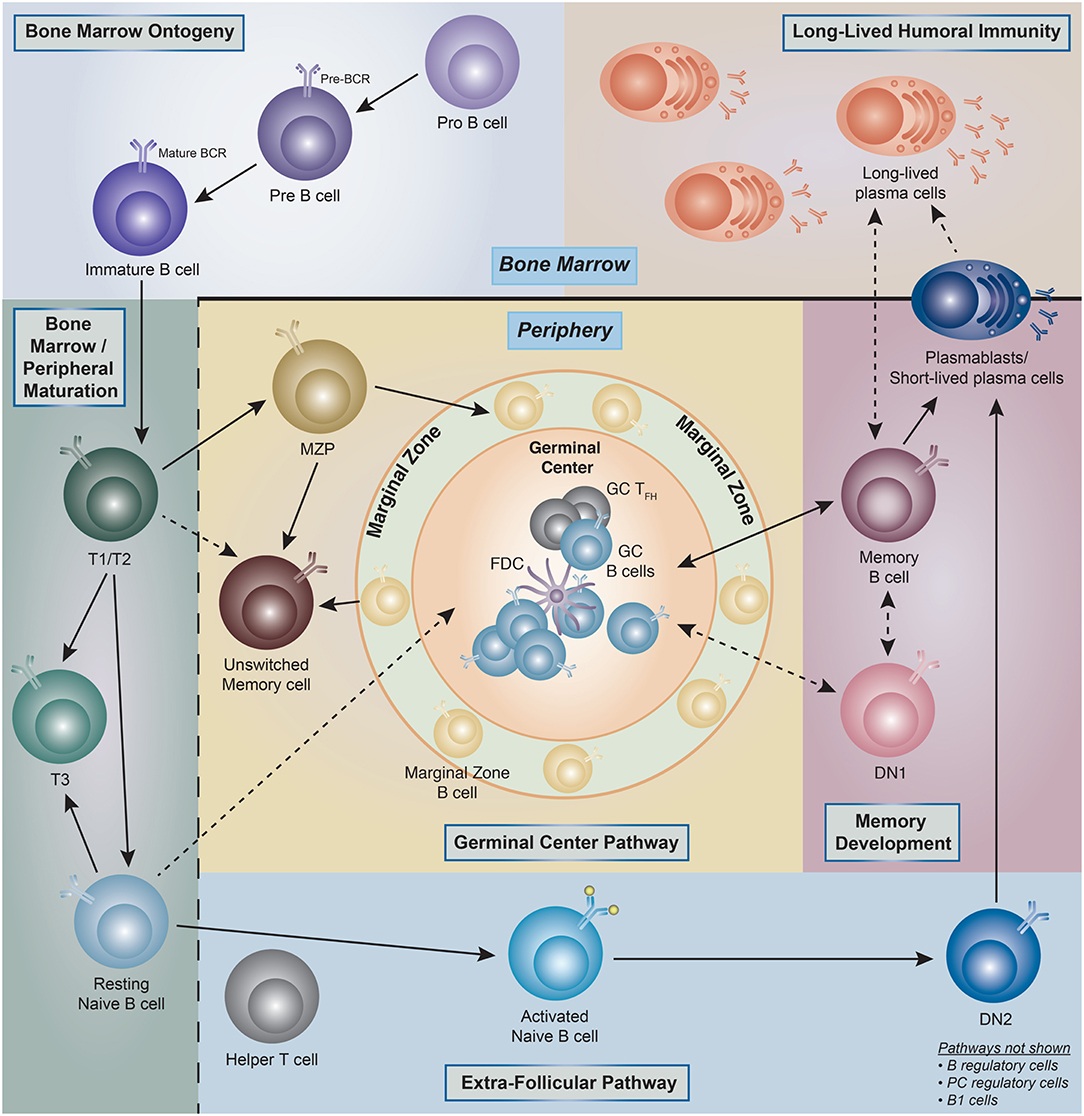
Activated B cells can undergo somatic hypermutation. This causes changes in their receptor genes. Cells with improved antigen binding are selected causing affinity maturation.
Class switching can also be investigated. This is when B cells change the antibody isotype they produce.
A study was performed looking at BCR repertoire changes in SARS-CoV-2 infected and vaccinated individuals. Differences were identified in clonality, antibody isotypes and somatic hypermutation (B Cell Receptor Repertoire Kinetics After SARS-CoV-2 Infection and Vaccination, 2022).
Using both TCR and BCR sequencing gives complementary information.

Bioinformatics
A large amount of data will be generated. This can only be useful if the data is carefully analysed. Specialised tools such as MiXCR can help sequence TCR and BCR data. This can help identify receptor sequences and assign V(D)J genes.
Other tools such as Immcantation can help with repertoire analysis.
This can help compare samples, look at diversity, identify expanding clonotypes and look at changes due to different experimental conditions.
Single cell sequencing can give additional information. This can link receptor sequences to gene expression profiles.
A study was performed looking at Antibody Repertoires and transcriptomes of around 100,000 B cells from mice after immunisation. This showed how single cell sequencing can link B cell characteristics to receptor and clonotype information (Generation of a Single-Cell B Cell Atlas of Antibody Repertoires and Transcriptomes to Identify Signatures Associated with Antigen Specificity, 2023).
There are some limitations to this. Just because you know the receptor sequence doesn’t mean you know what antigen it is targeting. The depth of sequencing, sample preparation, amplification bias and the choices made during analysis can all affect the outcome. Other techniques may be required to determine Antigen Specificity and functionality.
Immune repertoire sequencing allows you to go beyond just looking at antibody levels and actually see how the T and B cell populations respond, expand and change over time. When you combine that with bioinformatics analysis you can take the complex receptor data and turn it into real biological insights. That's why at GenomeBeans we think the right bioinformatics is absolutely key to making sense of the biological data and in turn to better research outcomes.
References
- Agrafiotis et al. (2023). Generation of a single-cell B cell atlas of antibody repertoires and transcriptomes to identify signatures associated with antigen specificity.
- https://doi.org/10.1016/j.isci.2023.106055
- Liu et al. (2021). The methods and advances of adaptive immune receptors repertoire sequencing.
- https://doi.org/10.7150/thno.61390
- Kotagiri et al. (2022). B cell receptor repertoire kinetics after SARS-CoV-2 infection and vaccination.
- https://doi.org/10.1016/j.celrep.2022.110393
- Pan et al. (2021). Vaccination reshapes the virus-specific T cell repertoire in unexposed adults.
- https://doi.org/10.1016/j.immuni.2021.04.023
- Teraguchi et al. (2020). Methods for sequence and structural analysis of B and T cell receptor repertoires.
- https://doi.org/10.1016/j.csbj.2020.07.008
Popular Post
-
02 November 2026
Which Bioinformatics Platform Fits Your RNA-seq Research? A Feature-by-Feature Comparison

-
27 October 2026
The Hidden Microbial World: How Metagenomics Reveals Microbes Beyond What We Can See
-
19 October 2026
Can No-Code Bioinformatics Replace Coding? Here’s Where It Helps

-
12 October 2026
Bioinformatics Tools Are Everywhere. Knowing Which One to Use Is the Hard Part
-
05 October 2026
Bioinformatics vs Data Science: What’s Actually Different?