


The Hidden Microbial World: How Metagenomics Reveals Microbes Beyond What We Can See
Microbes are everywhere. They're in the air we breathe, the water we drink, the soil beneath our feet, and even inside our bodies. Yet, most of this microbial world remains invisible to us.
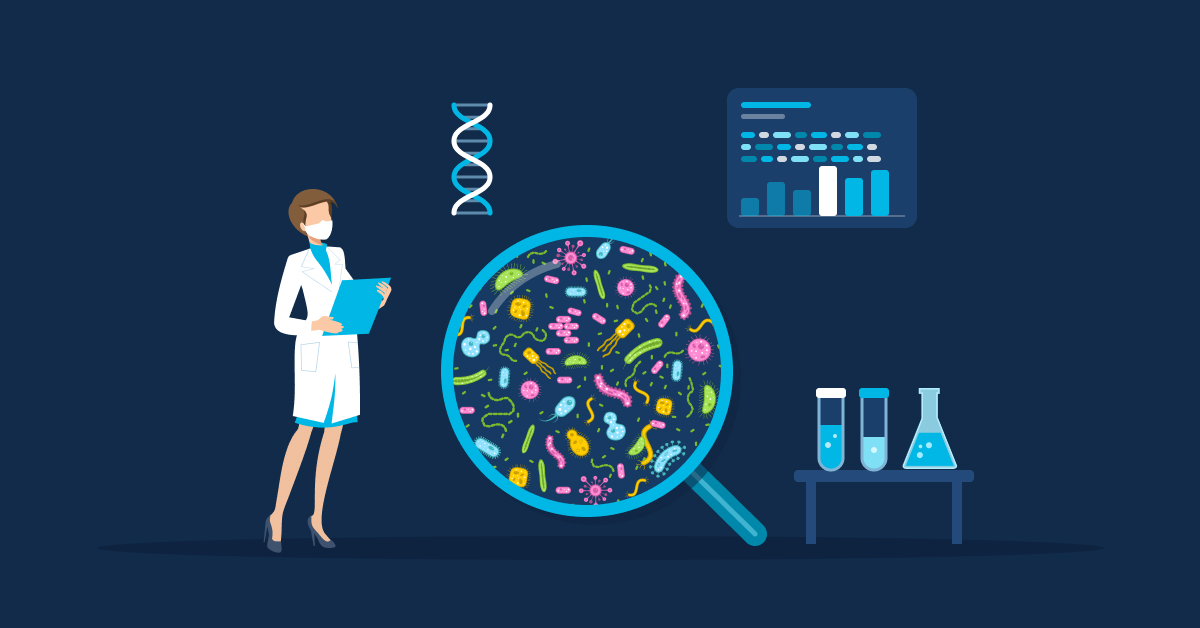
For decades, scientists have studied microorganisms by growing them in laboratories. This has helped us understand many microbial species, but there's a limitation.
Not every microorganism can be easily grown under standard laboratory conditions.
Some require very specific environments, while others depend on interactions with neighboring organisms to survive. So, how can researchers investigate microbes that are difficult to culture?
That's where metagenomics comes in.
Instead of growing microorganisms individually, metagenomics allows scientists to examine genetic material directly from environmental or biological samples.
This provides a broader picture of microbial communities, including organisms that traditional methods might miss.
What Is Metagenomics, and Why Does It Matter?
Metagenomics is the study of genetic material recovered directly from samples containing microbial communities, without needing to isolate and culture every organism.
Think about a single water sample.
It may contain bacteria, archaea, viruses, and microbial eukaryotes living together. Studying each microorganism separately would be challenging, especially when some cannot be easily cultured.
Through metagenomics sequencing, researchers can investigate the genetic information present in that sample and begin exploring the community.
This helps answer questions such as:
- Which microorganisms are present?
- How diverse is the microbial community?
- How does its composition change between samples?
- What biological functions might these organisms perform?
Metagenomics isn't just about finding more microbes. It's about understanding microbial communities as a whole.
Why Traditional Methods Cannot Reveal Every Microbe
Culture-based microbiology remains an important part of microbial research. It allows scientists to examine living organisms and study their behavior under controlled conditions.
But microorganisms don't all grow under the same conditions. Some require unusual nutrients or temperatures. Others rely on complex relationships with neighboring species. If those conditions aren't available in the laboratory, the organisms may remain undetected through culture-based methods.
Metagenomics approaches this problem differently. By analyzing DNA extracted directly from samples, researchers can investigate microorganisms without first growing them.
However, there's an important distinction.
Finding microbial DNA doesn't necessarily mean the organism is alive or metabolically active. The DNA could come from living cells, inactive organisms, or material remaining after cell death. Understanding these limitations is essential for interpreting results accurately.
Recent Research Shows How Much Microbial Diversity Remains Unexplored
Even with advances in sequencing technologies, scientists are still discovering how much microbial diversity has yet to be characterized.
A 2026 study published in Nature Microbiology, titled Unbinned contigs expand known diversity in the global microbiome, provides an interesting example.
Researchers examined 92,187 publicly available metagenomes, including genetic sequences that had not been assigned to reconstructed microbial genomes. Their analysis predicted approximately 705,000 bacterial and 27,000 archaeal species-level clades across the datasets.
These figures represent computationally predicted microbial lineages, not experimentally confirmed species.
Why does this matter?
Because some microbial diversity may remain hidden within sequencing data that researchers have already generated.
The challenge isn't always collecting more data. Sometimes, it's finding better ways to interpret what is already available.The study highlights the importance of continued improvements in microbial classification, genome reconstruction, and bioinformatics analysis.
How Metagenomics Reveals Hidden Microbial Communities
Metagenomics analysis involves several stages. Each contributes to turning raw sequencing data into meaningful biological information.
1. Collecting Samples and Extracting DNA
The process begins with collecting a biological or environmental sample.
Researchers extract DNA from the microbial community, which may contain genetic material from numerous microorganisms.
Sample preparation matters because different extraction methods can affect which organisms are represented in the final dataset.
2. Sequencing Microbial Genetic Material
Next-generation sequencing (NGS) technologies generate DNA sequence reads for further analysis.
Two commonly used approaches are:
- 16S rRNA gene sequencing: Targets a specific marker gene to investigate bacterial and archaeal community composition. It's often used for taxonomic profiling, although resolution depends on the sequenced region and reference database.
- Shotgun metagenomics: Sequences DNA more broadly, helping researchers investigate microbial composition, genetic diversity, and functional potential.
Neither approach is automatically better for every experiment. The choice depends on the research question, sample type, and required level of detail.
3. Processing and Analyzing Sequencing Data
Once sequencing is complete, researchers are left with raw data that needs processing.
This typically involves quality control, filtering, taxonomic classification, and, where relevant, sequence assembly or functional annotation.
Bioinformatics pipelines help organize these steps and support comparisons between samples. But the quality of the results also depends on the methods and reference databases used. An organism may remain unclassified when suitable reference sequences are unavailable, even if its DNA is present in the dataset.
4. Interpreting Microbial Diversity and Function
After processing, researchers can explore patterns in microbial communities.
They might compare microbial abundance across samples, investigate community differences, or identify genes associated with metabolic pathways. Still, detecting a gene doesn't automatically establish that a biological function is occurring.
That's why interpretation must consider experimental design, sample characteristics, and the limitations of the analytical approach.
What Can Metagenomics Tell Us About the Microbiome?
The term microbiome encompasses microbial communities, their genetic material, and the environments in which they exist.
Metagenomics allows researchers to investigate these communities at the genetic level.
For example, studying the human microbiome through metagenomics can reveal differences in microbial composition across body sites and help scientists explore potential relationships with human health.
Researchers commonly investigate:
- Microbial diversity: The variety of microorganisms within a community.
- Community composition: The relative representation of microbial groups.
- Functional potential: Genes associated with biological processes.
- Community changes: Differences across conditions, individuals, or time points.
These findings provide valuable insights, but they don't tell the entire story.
For instance, DNA-based metagenomics can suggest what microorganisms are genetically capable of doing. Studying which genes are actively expressed may require additional methods, such as metatranscriptomics.
Where Is Metagenomics Making a Difference?
Metagenomics is helping researchers investigate microbial communities across several fields.
| Field | Application Focus |
|---|---|
| Human microbiome research | Exploring microorganisms associated with the human body and their potential relationships with health and disease. |
| Environmental microbiology | Investigating microbial diversity in water, soil, oceans, and other environments to better understand ecological processes. |
| Wastewater surveillance | Studying microbial populations and genetic signatures relevant to environmental monitoring. |
| Microbial biotechnology | Identifying microbial genes and pathways with potential applications in enzyme discovery and other biotechnology research. |
Each application brings different questions, but all depend on suitable sequencing approaches and careful interpretation.
Turning Metagenomics Data Into Meaningful Insights
Sequencing technologies have made microbial genetic information more accessible. But analyzing that information is another challenge.
A single experiment can generate millions of sequencing reads.
Researchers must assess data quality, classify sequences, estimate microbial abundance, and interpret biological patterns. And when datasets contain unfamiliar organisms or poorly characterized genes, the analysis can become even more complicated.
This is where structured bioinformatics workflows become useful.
GenomeBeans provides an online metagenomics analysis workflow that supports researchers working with microbial sequencing data. By organizing computational analysis into structured steps, such platforms can help researchers spend less time managing repetitive processes and more time examining their findings.
The Microbial World Is Bigger Than What We Can See
Metagenomics has changed how researchers investigate microbial communities.
Organisms that are difficult to culture no longer have to remain entirely outside the scope of genetic investigation. And as recent research suggests, even existing sequencing datasets may contain microbial diversity that has not been fully characterized.
But identifying microbial DNA is only the beginning.
Understanding how microorganisms interact, which functions they perform, and how communities respond to changing conditions requires continued research. The more scientists explore the microbial world, the clearer it becomes that there's still much more to discover.
Research Reference
Prasoodanan et al. (2026). Unbinned contigs expand known diversity in the global microbiome. Nature Microbiology.
https://doi.org/10.1038/s41564-026-02314-6
Popular Post
-
19 October 2026
Can No-Code Bioinformatics Replace Coding? Here’s Where It Helps

-
12 October 2026
Bioinformatics Tools Are Everywhere. Knowing Which One to Use Is the Hard Part
-
05 October 2026
Bioinformatics vs Data Science: What’s Actually Different?
-
28 September 2026
How Scientists Use Bulk Transcriptomics to Understand What a Drug Does Inside Cells
-
21 September 2026
Inside a Brain, Cell by Cell: What Alzheimer's Research Looks Like at Single-Cell Resolution